
English 
Landline: +86-536-6066059
Email: qingyuanpackaging@gmail.com
Dawazi Village, High-tech Industrial Zone, Zhucheng City, 262200, Shandong Province, China


Views: Author: Site Editor Publish Time: 2026-10-13 Origin: Site


Retailers face a constant battle to stand out in crowded shopping districts. You need physical branding to make a lasting impression after the sale. Standard t-shirt bags often fail to capture this crucial post-purchase visibility. Unprinted packaging simply blends into the background.
Upgrading to a Die Cut Shopping Bag offers a structured, premium aesthetic. It acts as a mobile branding asset for your store. However, selecting the right material and print process is tricky. You must carefully evaluate unit economics, local compliance, and durability requirements.
This guide provides procurement and marketing teams with a concrete framework. You will learn how to evaluate, design, and source these packaging solutions. We show you how to align them perfectly alongside your brand positioning and retail operational needs.
Die cut shopping bags offer an unobstructed, flat print area that maximizes post-purchase brand visibility ("walking billboard" effect).
Material selection—ranging from LDPE shopping bags to heavy-weight paper and Mylar—dictates both the unit cost and the perceived brand value.
Procurement success relies on balancing Minimum Order Quantities (MOQs), gauge (thickness) requirements, and localized environmental compliance.
Vendor evaluation should prioritize sample testing for handle strength and print registration accuracy.
Many retailers view packaging merely as a sunk operational cost. We encourage shifting this perspective entirely. Packaging represents a measurable brand asset. Upgraded retail carrier bags deliver tangible returns on investment. They turn every exiting customer into a powerful brand ambassador.
Standard grocery bags serve one primary function. They carry items from point A to point B. A premium shopping bag does much more. It protects the merchandise while simultaneously communicating your brand identity. Shoppers subconsciously associate the quality of your packaging alongside the quality of your products. Flimsy materials signal cheap merchandise. Conversely, structured bags elevate the entire perceived value of the purchase.
Best Practice: Align your packaging budget closely alongside your marketing budget. Treat custom bags as direct consumer advertising. They often yield more localized impressions than digital ads.
A die cut shopping bag features a clean, punched-out handle. This specific structural integrity prevents the bag from bunching up around the customer's hand. Because the bag remains flat, your logo stays readable. Your marketing messages remain highly visible in high-traffic retail environments. Shoppers carrying your beautifully designed bags through malls act as walking billboards. They attract the eyes of potential new customers.
You must define what makes a packaging rollout successful. Procurement teams cannot rely on gut feelings alone. You need measurable benchmarks. Evaluate your next packaging upgrade using these core metrics:
Reduced Tear Rates: Track the percentage of bags failing during customer transit. Lower tear rates indicate better material choices.
Improved Customer Retention: High-quality packaging encourages shoppers to reuse the bags. This keeps your brand in their homes longer.
Social Media Unboxing Visibility: Beautiful packaging encourages customers to share their purchases online. Monitor user-generated content for your bags.
Regulatory Compliance: Ensure all materials meet local plastic bag bans and recycling mandates strictly.
Material selection dictates both your unit cost and your perceived brand value. You must choose a substrate carefully. It must reflect your store's identity while meeting practical durability needs.
Many retailers rely heavily on LDPE shopping bags for everyday operations. They provide an excellent balance of cost and performance.
Pros: LDPE offers high durability. It is naturally tear-resistant. The smooth surface allows for incredibly sharp print registration. These bags remain highly cost-effective at scale.
Best for: Apparel retailers, consumer electronics, and general merchandise stores. They suit brands seeking a glossy or matte premium finish perfectly.
Common Mistake: Choosing a gauge too thin for your heaviest items. Always test the specific mil thickness against your heaviest product combinations.
Paper bags provide a completely different tactile experience. They communicate traditional luxury and environmental awareness.
Pros: Paper aligns seamlessly alongside eco-conscious brand messaging. It is fully recyclable in standard municipal streams. It offers a tactile, boutique feel consumers love.
Best for: High-end cosmetics, sustainable fashion brands, and localized boutique shops.
Specialty materials serve very specific retail niches. Mylar stands out for its protective qualities.
Pros: Mylar provides superior barrier properties. It blocks moisture and odor effectively. It offers a distinct, metallic or matte shelf presence.
Best for: Food retail, specialty supplements, and localized perishable goods.
Table: Material Comparison for Retail Brands
Material Type | Primary Benefit | Ideal Retail Sector | Relative Cost at Scale |
|---|---|---|---|
LDPE (Low-Density Polyethylene) | Tear resistance and vibrant printing | Apparel, Electronics | Low to Medium |
Heavy-Weight Paper | Eco-conscious messaging, tactile feel | Cosmetics, Boutiques | Medium to High |
Specialty Mylar | Moisture/odor barrier properties | Food, Supplements | High |
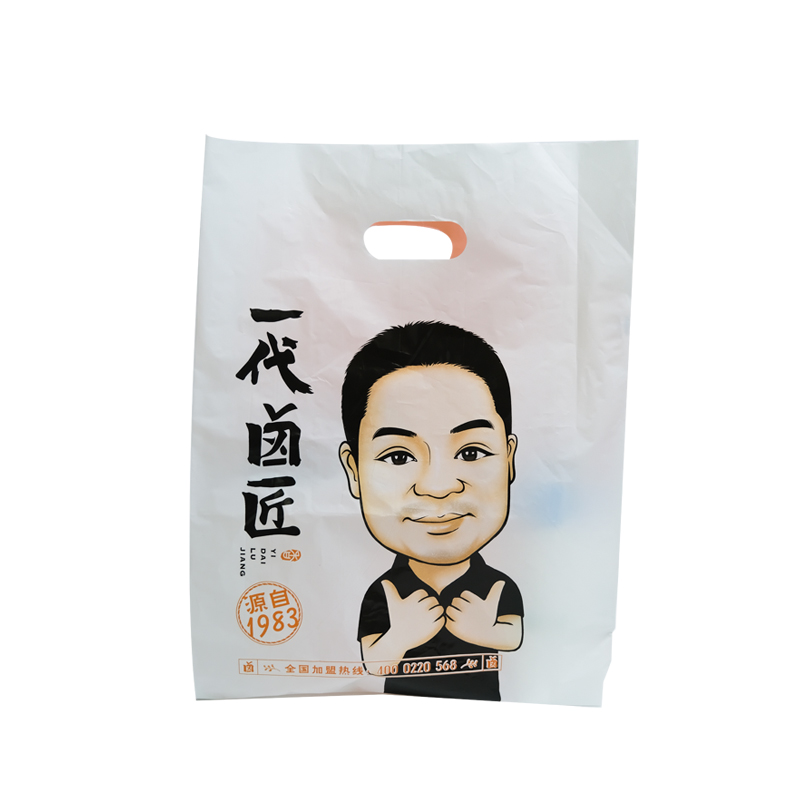
Your packaging is a blank canvas. You must optimize it to capture maximum attention. A well-designed bag elevates a simple purchase into a premium brand experience.
Leverage the guaranteed flat surface area beneath the die-cut handle. This area is your prime real estate. Centralize your logo placement here. Ensure your typography remains large enough to read from across a street. Do not clutter this space. Minimalist designs often project higher value than overly complicated graphics. Use negative space strategically to make your core message pop.
You must understand the technical realities of bulk printing. Different processes yield different results.
Flexographic vs. Digital Printing: Evaluate your cost-per-unit against the complexity of your brand's color palette. Flexographic printing utilizes polymer plates. It becomes highly economical for massive production runs. Digital printing requires no plates. It suits complex, multi-color gradients and smaller seasonal runs perfectly.
Color Psychology in Bulk: You must ensure Pantone matching consistency across large production runs. Slight color variations dilute your brand identity. Red bags trigger excitement and urgency. Blue conveys trust and calm. Ensure your chosen print vendor can guarantee exact Pantone matches consistently.
Printing on plastics and specialty papers carries inherent risks. You must actively avoid "ink bleed" and registration errors. Registration errors occur when different color layers misalign during printing. This creates a blurry, cheap-looking final product. Select vendors demonstrating proven high-gauge printing capabilities. Always request physical samples of their previous multi-color work before signing contracts.
Common Mistake: Approving digital proofs without seeing a physical draw-down. Computer screens render colors differently than physical substrates do. Always demand a physical color proof.
Beautiful designs mean nothing if the bags break your budget or violate local laws. Procurement teams must navigate unit economics carefully. You also need a firm grasp on regional compliance mandates.
Analyze how size, mil thickness (gauge), and ink layers impact your final cost-per-bag. Thicker bags cost more upfront. However, they reduce embarrassing handle tears. They also encourage customer reuse. Every additional ink color requires another pass on a flexographic press. This increases setup fees and per-unit costs. Standardizing your bag design to one or two colors can improve your unit economics drastically.
Factor in lead times for custom prints carefully. Domestic suppliers might deliver in four weeks. Overseas manufacturers might require twelve weeks. You must plan your ordering cycles around seasonal retail peaks. Furthermore, consider the warehouse footprint required for bulk B2B orders. Storing massive quantities of bags requires significant pallet space. Work closely with your logistics team. Ensure they have adequate racking space before placing massive bulk orders.
Plastic regulations change frequently. You must adapt your specifications to meet regional plastic bag bans. Many cities ban single-use thin plastics entirely. You can often bypass these bans by ensuring your bags qualify as "reusable." For example, ensure your LDPE shopping bags meet the minimum reusable thickness requirements. This typically means specifying a gauge of 2.25 mils or higher. Check your local municipal guidelines annually to avoid steep compliance fines.
Compliance Checklist:
Verify the minimum mil thickness required in your specific operating regions.
Confirm whether local laws mandate specific recycling symbols printed on the bottom gusset.
Check if you need to charge customers a mandatory bag fee at the point of sale.
Ensure your chosen substrate qualifies for local Store Drop-Off recycling programs.
Finding a reliable supplier is crucial for long-term retail success. Do not choose vendors based solely on the lowest quote. A cheap bag that tears easily damages your brand reputation instantly.
Decision-makers must test handle tear-strength personally. You should verify material opacity before committing to full MOQs (Minimum Order Quantities). Fill a sample bag with your heaviest merchandise. Carry it around your office for ten minutes. Does the die-cut handle stretch? Does it cut into your hand uncomfortably? If the handle distorts, you need a thicker gauge or a fold-over reinforced handle.
Ask critical questions during the vetting process. Do they offer scalable MOQs for seasonal retail promotions? You might need a small batch of holiday-themed bags in November. Do they provide transparent lead times for both domestic and overseas manufacturing? A reliable supplier communicates delays immediately. They offer solutions, not excuses.
Chart: Vendor Evaluation Matrix
Evaluation Criteria | Poor Supplier | Ideal Supplier |
|---|---|---|
Sample Policy | Refuses physical proofs | Provides free physical material samples readily |
MOQ Flexibility | Rigid high minimums only | Offers scalable MOQs for seasonal test runs |
Lead Time Transparency | Vague estimates ("soon") | Provides hard dates and tracks ocean freight |
Quality Assurance | No formal replacement policy | Guarantees exact Pantone matches and gauge accuracy |
Map out your transition carefully. Moving from plain stock bags to custom prints requires planning. Start a custom-branded pilot program in select flagship stores first. Gather feedback from your cashiers. Ask them if the bags open easily at the register. Monitor customer reactions. Once you validate the material and design, you can confidently roll the new packaging out nationwide.
A die cut shopping bag represents a strategic intersection of marketing and procurement. When specified correctly, it protects the product flawlessly. It also actively extends your brand reach far beyond the store exit. Retailers who invest in premium, flat-canvas packaging reap the rewards of increased post-purchase visibility.
Take action today. Encourage your procurement managers to audit your current bag tear-rates immediately. Request physical material samples across LDPE, paper, and Mylar categories. Begin a thorough cost-benefit analysis to find the perfect balance between brand impact and operational efficiency.
A: It depends heavily on the mil thickness and the material composition. A standard 2.0 mil LDPE bag handles lighter apparel easily. However, fold-over reinforced die cuts support significantly more weight without stretching. They are usually rated safely for 5–15 lbs depending on the final gauge.
A: Yes, many meet strict compliance standards if properly specified. You must meet local reusable thickness thresholds. This is often 2.25 mil or higher. Customers can typically recycle these thicker bags through standard Store Drop-Off programs located at most local supermarkets.
A: You should plan for realistic timelines to avoid inventory stockouts. Expect 3–6 weeks for domestic production runs. Overseas manufacturing typically requires 8–12 weeks. Always factor in extra time to review and carefully approve pre-production physical proofs before mass manufacturing begins.


