
English 
Landline: +86-536-6066059
Email: qingyuanpackaging@gmail.com
Dawazi Village, High-tech Industrial Zone, Zhucheng City, 262200, Shandong Province, China


Views: Author: Site Editor Publish Time: 2026-03-03 Origin: Site


Choosing the right Die Cut Shopping Bag size is more important than many buyers expect. Size affects not only whether your product fits, but also how comfortable it is to carry, how strong the handle area needs to be, and how much branding space you get on the front and back panels. For retailers, event organizers, and wholesalers, selecting the correct dimensions can reduce returns, minimize bag breakage, and improve the customer’s overall impression of your brand. Below is a practical guide to how die cut shopping bag sizes are measured, what standard sizes are common, and how to choose the best option for your products.
Most Die Cut Shopping Bag sizes are described as Width × Height, and if the bag has a gusset, it’s often written as Width × Height + Gusset (or W × H × G). Width is measured across the front of the bag when laid flat. Height is measured from the bottom to the top edge. The gusset is the extra fold-out depth (bottom gusset and/or side gusset) that increases the bag’s volume and allows it to hold bulkier items without stressing the film.
When comparing two bags with the same width and height, the gusseted one can hold noticeably more because it creates a three-dimensional base. That extra depth helps boxed goods sit more naturally, improves stability, and often reduces “bulging” that can strain the handle area.
Die cut shopping bags have a cut-out handle near the top. This means there is usually a “headspace” area above the product, and the usable fill height is slightly less than the stated overall height. Handle placement matters because if the cut-out is too close to the edge, it can tear more easily; if it’s too low, it reduces printable area or usable space.
For higher loads, buyers often choose reinforced solutions such as patch handle reinforcement or thicker material around the handle zone. Even if the bag dimensions are correct, the handle area must be designed to support the product weight without ripping.
Small Die Cut Shopping Bag sizes are popular for cosmetics, pharmacies, small gifts, accessories, and promotional giveaways. These bags are designed for light-to-medium loads and usually focus on neat appearance, easy carrying, and cost efficiency. The main sizing goal for small bags is to fit compact products without leaving excessive extra space, which can look unprofessional and waste material.
Small bags are also common for event branding because they are easy to distribute, store, and transport in bulk. If your items are small but heavy (such as glass bottles or metal components), you may still need a stronger film thickness or handle reinforcement even in a small size.
Medium sizes are widely used for clothing stores, boutiques, gift shops, and general retail. They provide enough space for folded apparel, small shoeboxes, or multiple items in a single purchase. Large die cut shopping bags are often chosen for jackets, larger boxes, seasonal gift sets, or bulkier retail packaging.
As bag size increases, strength requirements rise because a larger bag encourages heavier loads. Medium-to-large bags often benefit from gussets and reinforcement options to prevent tearing, especially around the handle zone and top edge where lifting forces concentrate.
A simple rule for selecting a Die Cut Shopping Bag is to match the bag width to the product’s widest side with enough allowance for easy insertion. If the bag is too narrow, the product will push outward, creating stress points that can tear the film—often near the handle and upper corners. If the bag is too wide, the product may shift inside and create an awkward carrying feel, while also increasing cost and storage volume.
If your product is boxed, measure the box width and depth. A gusseted bag can often use a slightly smaller front width because the gusset provides the missing depth for a better fit.
Height should include extra space for practical handling. Many retailers want room at the top for folding, sealing with stickers, or keeping the product covered. If you plan to add a label, hangtag, or closure, add additional height so the top can fold without compressing the product.
Also consider how your staff packs items. If packing must be fast, slightly more height can reduce friction and speed up insertion, especially for products with rigid edges.
A bigger Die Cut Shopping Bag often carries heavier items, and heavier items increase stress at the handle and top edge. Even if the film doesn’t puncture, the handle cut-out area can tear if the bag is not engineered for load. For larger sizes, upgrading film thickness, using stronger resin blends, or selecting multi-layer structures can improve tear resistance and carrying confidence.
Strength is not only about thickness—seal quality and uniform film gauge also matter. A bag with inconsistent thickness may have weak areas that tear under load even if the average thickness seems sufficient.
If your products are heavy, sharp-edged, or frequently carried long distances, consider reinforcement. Patch handle reinforcement adds an extra layer in the handle zone, spreading the load and reducing tear risk. Reinforced die-cut designs can dramatically improve performance without increasing thickness across the entire bag, which helps balance cost and strength.
For premium retail brands, reinforcement also improves the user experience—customers feel the bag is sturdy, which reflects positively on the brand.
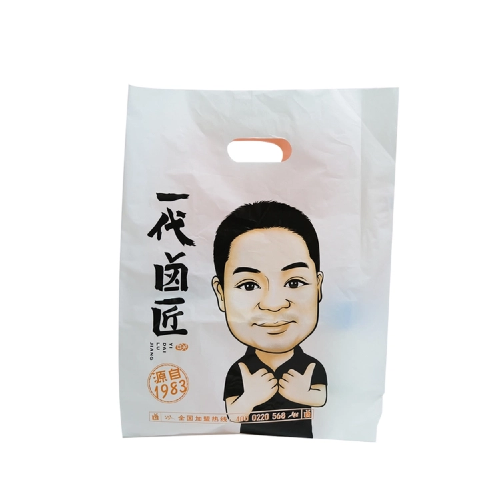
Gussets increase capacity and improve fit for boxes, stacked products, and multiple-item purchases. A gusseted Die Cut Shopping Bag sits more naturally around a rectangular box, making the package look cleaner and reducing stress on the film. Gussets can also improve stability when the bag is set down, which is helpful in retail environments.
For items like food containers, gift boxes, or product kits, gussets often provide the best balance of fit and appearance.
Flat die cut shopping bags are ideal for slim products like brochures, apparel in thin packaging, lightweight accessories, or documents. They require less material and often pack more efficiently in cartons, saving shipping and storage costs. Flat bags also present a smooth printing surface, which can be great for branding and promotional designs.
If your products are consistently slim and light, flat sizes can be the most economical choice without sacrificing presentation.
When ordering custom Die Cut Shopping Bag sizes, suppliers typically need three key details: product dimensions, average weight per bag, and how items will be packed (single item, multiple items, boxed, etc.). Providing photos of the packed product can also help avoid sizing mistakes.
It’s also useful to describe the use scenario—retail counter, trade show, delivery, or take-away—because handling conditions influence durability requirements.
Size affects branding space, logo placement, and readability. Your artwork should include safe margins and avoid critical elements too close to the edges or handle cut-out. If you want large logos, premium graphics, or full coverage prints, choosing a slightly larger bag may improve visibility and reduce design constraints.
In many cases, the “best” size is the one that makes your branding look intentional—neither cramped nor lost on a huge empty panel.
Before mass production, test samples with real products. Check fit, ease of packing, carry comfort, and handle performance under realistic weight. Try lifting with one hand and carrying for a short distance—this quickly reveals whether the handle needs reinforcement or whether the bag is too narrow.
Sampling is especially important if you sell seasonal products or gift sets that change in size across the year.
Bag size affects how many pieces fit per carton and how much warehouse space you need. Larger bags usually take more carton volume, increasing freight costs. If you order for multiple store locations, optimizing carton efficiency can reduce overall logistics expenses.
For large campaigns or national distribution, a slightly adjusted bag size can produce meaningful cost savings while still meeting product-fit requirements.
Many clothing retailers prefer medium sizes that fit folded shirts or light apparel sets comfortably. The best “popular” size depends on your typical product mix and whether you use gussets for added capacity.
Add allowance in both width and height to avoid tight contact that can create stress points. For rigid boxes, gussets are often recommended to improve fit and reduce corner pressure.
Mixed sizes are often possible, but each size may have its own MOQ and setup requirements. Consolidating designs or using fewer size variants can improve cost efficiency.
The measurement method is similar, but material behavior differs. Non-woven bags have more structure and thickness, while PE bags may need sizing allowance based on film flexibility and gusset design.
Die Cut Shopping Bag sizes range from small to large and are typically measured by width × height, with optional gusset depth for added capacity. The best choice depends on product dimensions, weight, packing method, and the level of handle reinforcement needed. By combining smart sizing with appropriate material strength and sample testing, you can choose a bag that protects products, carries comfortably, and presents your branding professionally.


